Showing posts with label Atari. Show all posts

Retro Computers - Atari 2600 - Retro Computers

Atari 2600Atari 2600
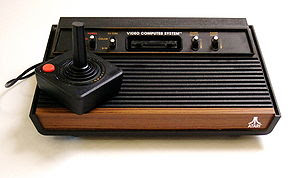
The Atari 2600 is not a computer as such - but with it being such a classic games system we've got to include it!

So, the Atari 2600 has the honour of being the first games console to appear on our site!

The Atari 2600 is a video game console that was released in October of 1977. It must go down as the console that kick-started the use of microprocessor based hardware and switchable cartridges containing game code, instead of having non-microprocessor dedicated hardware with all games 'built in' to the system.

The Fairchild Channel F was probably the first cart based system (the previous year in 1976) - however the Atari 2600 is credited with making the plug-in and play concept popular among the home gamers.

Originally known as the Atari VCS (which stood for Video Computer System) the machine's name was changed to Atari 2600 (taken from the unit's Atari part number CX2600) in 1982 following the release of the more advanced Atari 5200.

The Atari 2600 was typically bundled with two joysticks (those classic Atari sticks), a conjoined pair of paddle controllers and a cartridge game. The bundled game was initially Combat 4, then later became the classic Pac Man.

The Atari 2600 was massive. During the 1980s, 'Atari' was a synonym for this model in mainstream media and became the name that represented video games in general. In later years 'Nintendo' and 'PlayStation' had the same effect.

Classic Atari Joystick
The initial price of the console was US$199 including the two joysticks and Combat cartridge. It was up against the aforementioned Channel F (which was known as the VCS)

However, both systems ended up in the midst of a vicious round of price-cutting.

Pong clones made obsolete by these newer and more powerful machines sold off their boxes at budget prices. Many of the clone companies ended up out of business (a shame), and both Fairchild and Atari were selling consoles to a public that was completely fed up with 'Pong' type games.

When Fairchild stopped manufacturing consoles (a poor decision - they had reckoned that video games were a 'passing fad') it left Atari with a clear road to produce hardware and software.

Programmers soon began to push the Atari hardware and more impressive titles were created for the machine. This had a snowball effect and the Atari 2600 became more and more popular.

By 1979, the Atari 2600 was the best-selling Christmas gift (and console), mainly because of its exclusive content. Roughly 1 million units were sold that year!

Atari struck a good deal and licensed the smash arcade game Space Invaders, which increased the unit's popularity - 2 million units were sold the following year! (Space Invaders was mega-popular for a good couple of years)

The cartridge system was behind the success of the Atari 2600. Now the mere fact that you could play hundreds of different games on one console was way advanced to what had been on offer in the recent past.

In 1980 the Atari 2600 was given a minor revision in which the left and right difficulty switches were moved to the back of the console. In 1982 another version of the four-switch console was released without woodgrain (people tend to prefer the original woodgrain version nicknamed 'Woody').

The newer units were nicknamed 'Darth Vader' consoles due to their all-black appearance. These were also the first consoles to be officially called Atari 2600, as the Atari 5200 was released the same year.

As programmers became more proficient with the hardware, more and more games were released. It's vast (for the release time) array of colours (128 in NTSC mode) allowed full colour graphics in games - a far cry from the monochrome days of bat'n ball efforts.

Not only that - the system was capable of producing decent sound effects and musical jingles.

Programmers learned how to maximise the use of the Atari's bitmapped sprites and could even make game characters change colour 'on the fly' - again a superb feature in a video game.

Over the years Atari themselves developed many classic games such as Yars Revenge, Adventure and the seminal Breakout. Other well known developers such as Activison created titles such as Pitfall which sold over 4 million copies. Incredible.

The Atari 2600 cannot be underestimated - it really did usher in the modern era of home console gaming.

We recommend trying to pick up one of these machines.
Look at computers for sale online or even locally.

If you don't want to get hold of the real hardware then try and download an emulator and download those classic games. Alternatively you could try and play them online.

The classic Atari logo
Retro Computers and Classic Games is what we are all about...

Retro Computers - Atari ST - Retro computer

Atari ST


Atari ST
Let the battle of the 16-bit heavyweights commence!

The Atari ST was a classic home computer that was commercially available from 1985 into the early 1990s. Released by Atari, this 16-bit machine was designed to supercede their 8-bit XL range, and supercede them it did.

The 'ST' officialy stood for 'Sixteen/Thirty two' which referred to the CPU (a Motorola 68000 which had a 16-bit external bus and 32-bit internals). But let's not get too technical here, the Atari ST was a fine games machine, and it, along with the Commodore Amiga really pushed the envelope of computer gaming - with both becoming classic games machines (with some good conversions of arcade games).

The machine came installed with 512KB of RAM (more could be installed if you so desired), and 3½" floppy disks as storage. It was similar to other contemporary machines of the era which utilised the Motorola 68000 as the engine, (such as the Apple Mac and the Commodore Amiga). Although the Macintosh was the first widely available computer with a GUI, it was limited to a monochromatic display on a smaller built-in monitor, and people wanted colour and zingy graphics.

The ST preceded the Amiga's commercial release by almost two months, giving it a head start in the 16-bit battle that was to ensue. Atari's machine was the first computer to come with a fully bit-mapped color GUI (Graphical User Interface) using a version of Digital Research's GEM released in February of 1985. It was also the first home computer with integrated MIDI support.

Platform rivalry (between Atari and Commodore) was often reflected by the owners and was most prominent in the Demo Scene. Where the Amiga had custom processors which gave it the edge in the arcade games and video market, the ST was generally cheaper, had a slightly faster CPU, (and had a high-resolution monochrome display mode), which was ideal for business and CAD.

Thanks to its built-in MIDI ports it enjoyed alot of success as a music sequencer and as a controller of musical instruments among amateurs and professionals alike. Bands such as Tangerine Dream and Fatboy Slim used the ST when making music.

In some markets, particularly in Germany the machine gained a strong foothold as a small business machine for CAD and Desktop publishing work.

So, the ST was highly versatile, and was appealing to a broad range of users. At this point alot of home geeks (like yours truly) were leaving behind their beloved 8-bit machines and moving into the more powerful 16-bit market. The ST did well (once the price of one dropped), and became a popular choice for home enthusiasts, musicians, artists and arcade games players. It should be noted that an ST cost an incredible £749 when first released.

A lot of people wandered into their local Dixons, looked at the price, collapsed, stood up, checked the label to make sure their eyes weren't playing tricks on them, then went home sobbing. It would be worth waiting a year for the price to come down into mere mortal territory.

A large library of classic games was available for the ST (many games being improved versions of older 8-bit games such as Elite), and of course loading them in from a floppy disk as opposed to a cassette was a delight. The ZX Spectrum / Commodore 64 rivaly now shifted and became the Atari ST / Commodore Amiga rivaly, with playground arguments breaking out up and down the land.

The rivalry lasted for a few years as both companies released newer versions of their respective machines, such as the ST+ which now came installed with a mighty 1MB of RAM - how could that amount of memory ever be filled eh?

To be honest, it is probably fair to say that Commodores machine had the edge when it came to computer gaming. Most of the time, games were released on both formats, but the Amiga version usually had the edge. But is was a fine edge, a thinly veiled edge that could not be calculated, weighed or measured. The Amigas' graphics were usually better, sometimes the ST had a slight edge with sound. We could go on, but we won't.

Just remember a great machine that helped to usher in the era of powerful machines in the home. All hail Atari's 16-bit beaut - a fine Retro computer.

We recommend trying to pick up one of these machines.
Look at computers for sale online or even locally.

If you don't want to get hold of the real hardware then try and download an emulator and download those classic games. Alternatively you could try and play them online.

MACHINE NAME: 520 ST / ST+ / STM
MANUFACTURER: Atari
MACHINE TYPE: Home Computer (classic games machine)
COUNTRY OF ORIGIN: USA
RELEASE YEAR: 1985
KEYBOARD: Full-stroke keyboard with numeric and editing keypads
CPU: Motorola MC68000
SPEED: 8 mHz
CO-PROCESSOR: 'Shifter' and 'Glue' custom chips
RAM: 512 KB (520 ST/STM), 1 MB (520 ST+)
ROM: 192 KB
TEXT MODES: 40 or 80 columns x 25 lines
GRAPHIC MODES: 320 x 200 / 640 x 200 / 640 x 400 dots
COLORS: 16 among 512 (320 x 200) / 4 among 512 (640 x 200) / monochrome (640 x 400) this last mode required a special monitor for i to be displayed
SOUND: 3 voices over 8 octaves
SIZE / WEIGHT: 47 (W) x 24 (D) x 6 (H) cm
I/O PORTS: RGB, TV modulator (520STm), Cardridge, Midi (in/out), Centronics, RS232c, Hard Disk, Floppy Disk, Joystick, Mouse
BUILT IN MEDIA: External 3.5'' 360 KB disk-drive (option)
OS: TOS / GEM
POWER SUPPLY: External power supply unit
PRICE: £749 (1985 - UK) dropping to a more realistic £399 (1986 - UK)

Retro Computers and Classic Games is what we are all about...

Retro Computers - Atari 800 XL - Retro computer

Atari 800 XL


AT-AT's were well built

The Atari 800XL was the successor to the Atari 600XL. It was practically the same machine except it now had composite video capability and more RAM in the shape of 64KB - much more like it eh?

We must take a moment to mention the build quality of these Atari machines: They were very robust (almost nearing the indestructable levels of the BBC micro) and solid. They could take a lot of punishment and they would keep on grinnin'. Heck they were even impervious to kryptonite.

They had a responsive keyboard which would give you a nice 'clackity clack' sound as you hammered away at your latest BASIC program, and of course the function keys down the right hand side were solid enough.

The 800XL went on to become a popular choice for the classic games player, and over time an extensive library of games was released for it. It had the graphics and sound capabilites, and it almost reached the level of the legendary ZX Spectrum and Commodore 64 in the games playing stakes. Many games were now being released on multi-format, so you would have versions of a game for the Commodore, Sinclair, Amstrad and Atari machines.

One aspect of the XL range made them stand out from the 8-bit crowd of the mid-eighties. This was the cartridge slot - giving you another means of storing and loading those all important games. No waiting around for blocks of data to be loaded in from your trusty tape player and messing around with volume and tone controls. In some ways Atari were ahead of the pack with their technology.

The 800XL was a fine machine, and is worth it's place in the 8-bit hall of fame.

Ok readers, give this machine a hearty handshake. A fine Retro computer.

We recommend trying to pick up one of these machines.
Look at computers for sale online or even locally.

If you don't want to get hold of the real hardware then try and download an emulator and download those classic games. Alternatively you could try and play them online.

MACHINE NAME: Atari 800 XL
MANUFACTURER: Atari
MACHINE TYPE: Home 8-Bit micro (classic games machine)
COUNTRY OF ORIGIN: USA
RELEASE YEAR: 1982
END OF PRODUCTION: January 85
BUILT IN LANGUAGE(S): Atari Basic
KEYBOARD: Mechanical keyboard
CPU: MOS 6502C
SPEED: 1.79 (NTSC) / 1.77 (PAL) MHz
CO-PROCESSOR: GTIA (video), POKEY (sound, I/O), ANTIC (video)
RAM: 16 KB (600 XL up to 64 KB) / 64 KB (800 XL, expandable to 128 KB)
ROM: 24 KB
TEXT MODES: five text modes, max: 40 x 24, min: 20 x 12
GRAPHIC MODES: 16 graphic modes, maximum : 320 x 192
COLORS: 256 (16 colors with 16 intensities)
SOUND: 4 voices over 3.5 octaves
I/O PORTS: Composite video output, cartridge slot, peripheral port (SIO), parallel bus, 2 joystick ports
POWER SUPPLY: External power supply unit
PRICE: ?

Retro Computers and Classic Games is what we are all about...

Retro Computers - Atari 600XL - Retro computer

Atari 600XL
Atari 600 XL
Everyone say ta.

The Atari 600XL was released in 1983. It was Atari's low end replacement for the now discontinued Atari 400 personal computer.

Like other 1983'ers it came with an inbuilt 16KB of memory, it's own version of BASIC and it also had a PBI Parallel Bus Interface on the rear of the unit to acomodate Parallel Bus expansion devices. Devices such as the Atari 1064 64K memory module and the Atari 1090XL Expansion System. You could go upgrade crazy if you wanted to.

The Atari 600XL like it's younger brother the Atari 400 lacked a composite video output port. Atari Home Computer Division engineers revealed that originally the Atari 600XL was going to have composite video, but it was cut from the final design to reduce costs.

A good range of games was released (many by Atari as you might imagine!) for the Atari machines, but developers began to favour the 800XL when it was released as it had more memory in the shape of 64KB. Machines with 16KB never really stood the test of time (look at what happened to the 16KB Spectrum and the 16KB Oric 1), with many users upgrading them where possible or buying a newer model.

The Atari 600XL looked slightly smaller in dimensions than the 800XL. In fact, the 800XL was actually a similar machine, it had more memory (64KB as we have established) and the all important composite video. All peripherals were compatibe with both machines, which is always a smart move. But then Atari always did know what they were doing.

The machine was capable or decent graphics (it had a range of 256 colours each with 16 levels of 'intensity'), and could also produce good sound effects and music. These were always important factors where games developers were concerned. There were plenty of games released on the machine that had that 'Atari feel'. Nice.

The BASIC built in was pretty good, comparable to other 8-bit machines of the era. It had no major issues or problems and users could knock up quick basic programs if they wanted to.

The machine itself looked quite cool, the black case with the white top outline and silver function keys down the right hand side certainly made it more handsome than most other rivals.

Folks, toast Atari and remember the days when they were a major player in the hardware sector. A fine Retro computer.

We recommend trying to pick up one of these machines.
Look at computers for sale online or even locally.

If you don't want to get hold of the real hardware then try and download an emulator and download those classic games. Alternatively you could try and play them online.

MACHINE NAME: Atari 600XL
MANUFACTURER: Atari Corporation
MACHINE TYPE: Home 8-Bit micro (classic games machine)
COUNTRY OF ORIGIN: USA
RELEASE YEAR: 1982
END OF PRODUCTION: January 1985?
BUILT IN LANGUAGE(S): Atari Basic
KEYBOARD: QWERTY mechanical keyboard
CPU: MOS 6502C
SPEED: 1.79 MHz (NTSC) or 1.77 MHz (PAL)
CO-PROCESSOR: GTIA (video), POKEY (sound, I/O), ANTIC (video)
RAM: 16 KB (600 XL expandable up to 64 KB) / 64 KB (800 XL expandable to 128 KB)
ROM: 24 KB
TEXT MODES: five text modes, max: 40 x 24, min: 20 x 12
GRAPHIC MODES: 16 graphic modes, maximum : 320 x 192
COLORS: 256 (16 colors with 16 intensities)
SOUND: 4 voices, 3.5 octaves
I/O PORTS: Composite video output, cartridge slot, peripheral port (SIO), parallel bus, two joystick ports
POWER SUPPLY: External power supply unit
PRICE: ?

Retro Computers and Classic Games is what we are all about...

Followers